

The answer is more practical than that. A golf cart battery is not only a voltage and amp-hour label. The real golf cart lithium battery cost depends on the cells, usable capacity, discharge current, BMS design, enclosure, conductors, accessories, testing, documents and after-sales support behind the pack.
For commercial buyers, the goal is not to choose the cheapest battery or the most expensive battery. The goal is to compare quotations correctly and select the lowest-cost configuration that safely fits the vehicle, route, load and installation requirements.
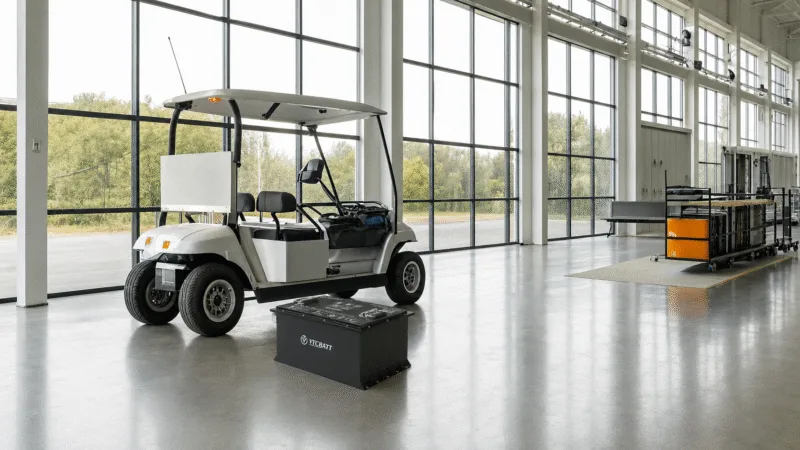
Golf Cart Lithium Battery Cost Is a Complete-System Cost
A useful quotation should show what is included. If one supplier quotes only a battery pack and another supplier includes a matched charger, SOC display, communication function, installation cables, test records and warranty support, the two prices are not directly comparable.
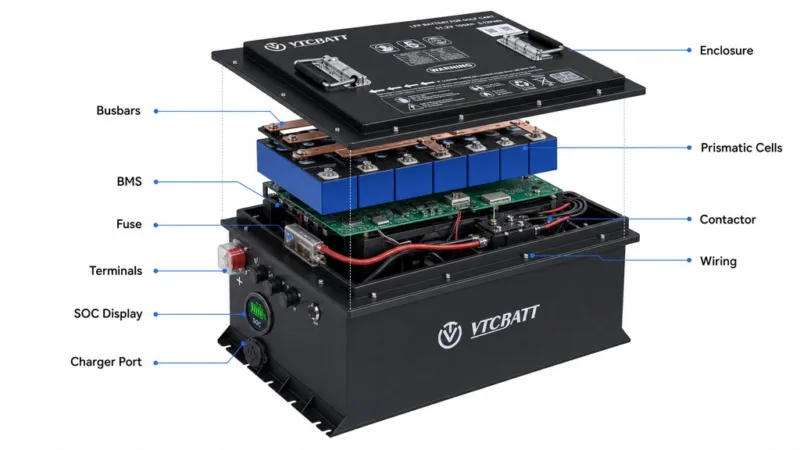
The visible battery case may look similar, but the internal design can be very different. One battery may use traceable new cells, a higher-current golf cart battery BMS, thicker busbars, larger cables, a stronger connector set and complete final testing. Another may be a simpler battery-only pack intended for a standard cart with moderate current demand.
This is why 48V golf cart battery cost should be compared as a complete system. Buyers need to check what the battery is designed to do, what accessories are included and what evidence the supplier can provide.
| Cost driver | What may change | Why it affects value |
| Cells | Cell manufacturer, format, production batch, capacity margin, internal resistance and matching records | Cells strongly influence capacity, power delivery, life and service risk. |
| BMS | Continuous current, peak current duration, protection functions, thermal design, Bluetooth, CAN or RS485 | The golf cart battery BMS determines whether the pack can handle acceleration, hills and controller demand. |
| Conductors and enclosure | Busbars, cables, terminals, connectors, fuse, contactor, housing material, IP requirement and mounting design | These parts affect heat, voltage drop, vibration resistance and installation fit. |
| Accessories | Charger, SOC display, harness, brackets, adapter cables and drop-in replacement kit | A lower battery-only price may lead to extra installation cost. |
| Testing and documents | Capacity test, load test, BMS test, aging, final inspection, UN38.3 or transport documents | Testing and documentation reduce uncertainty for commercial buyers. |
| Warranty and support | Diagnosis process, spare parts, replacement policy and engineering support | Important for fleets, distributors and OEM projects where downtime has a cost. |
Cell Quality and Matching Create the First Price Difference
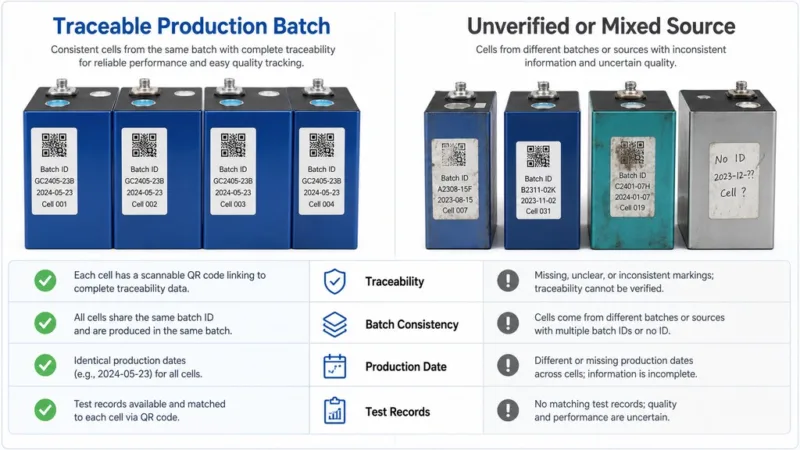
LiFePO4 cells are usually the largest material cost in a golf cart lithium battery. However, the price difference is not only about cell brand names. Buyers should ask whether the supplier can identify the cell model, production batch, production date, capacity range, internal-resistance range and matching process.
A typical 51.2V LiFePO4 golf cart battery uses sixteen cells connected in series. In a series-connected pack, the same current passes through every cell. If one cell has lower capacity, higher internal resistance or faster self-discharge, that one cell can limit the whole battery. The BMS may stop charging or discharging earlier to protect the pack, even when the other cells still have available energy.
This is one reason two batteries with the same 100Ah label may not deliver the same user experience. Better cell matching can improve usable capacity, voltage stability and long-term pack balance. It also requires testing equipment, process time and production control, which can increase cost.
Buyers should be careful with simple claims such as A-grade or B-grade. A lower-priced battery should not automatically be described as using poor cells. Some manufacturers reduce cost through higher purchase volume, standardized designs or fewer accessories. The practical question is whether the cell source and performance records are clear enough for the intended application.
Cell format can also affect manufacturing cost. Large prismatic cells often reduce the number of connections in a standard 16S golf cart battery. Cylindrical-cell designs can offer flexible packaging but may require many welds and inspection points. Pouch cells can fit special shapes but need careful mechanical compression and protection. None of these formats is automatically best. The right choice depends on current demand, available space, validation and service strategy.
The Same 100Ah Label May Not Mean the Same Usable Capacity
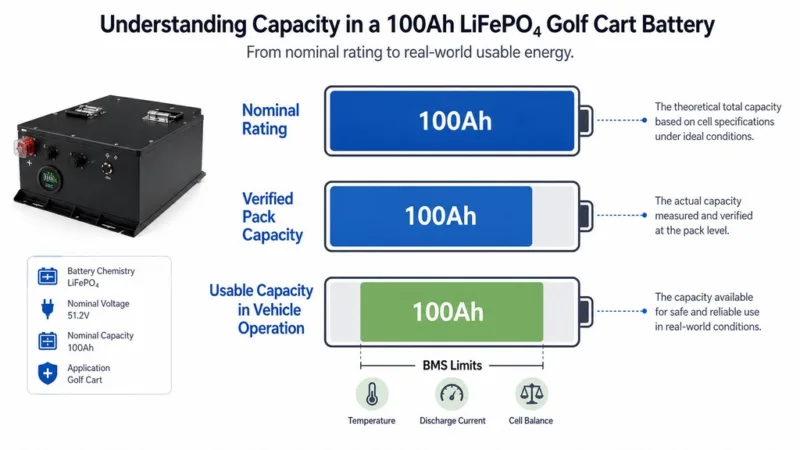
Capacity is another area where quotations can look similar while the real value differs. A 100Ah label is only meaningful when the test conditions are clear. One battery may use a nominal rating. Another may guarantee a minimum measured capacity at pack level. A third may have no clear capacity test record at all.
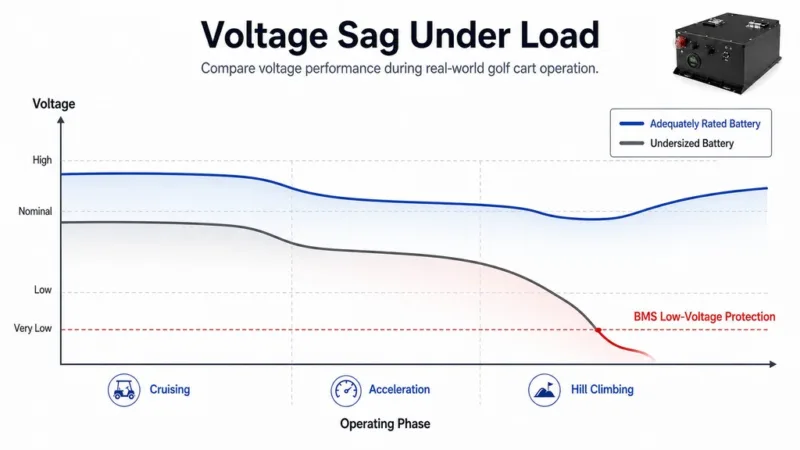
Capacity can change with temperature, discharge current, cutoff voltage, charging method, cell balance and BMS reserve settings. A battery that measures close to 100Ah at a low discharge current in a laboratory may deliver less usable energy during heavy acceleration or hill climbing if voltage sag causes the BMS or vehicle controller to reach a protection limit early.
A manufacturer that verifies capacity needs more process control. This may include incoming cell testing, internal-resistance matching, self-discharge screening, finished-pack charging, full discharge testing and serial-number traceability. These steps add equipment time and labor, but they give the buyer stronger evidence than an amp-hour label alone.
When comparing 48V or 51.2V 100Ah batteries, buyers should ask whether 100Ah is nominal, typical or guaranteed minimum capacity. They should also ask whether the result is measured at cell level or pack level, what temperature and discharge current were used, what cutoff voltage was applied and whether a discharge report is available.
Current Capability Often Explains a Big Part of the Price Gap
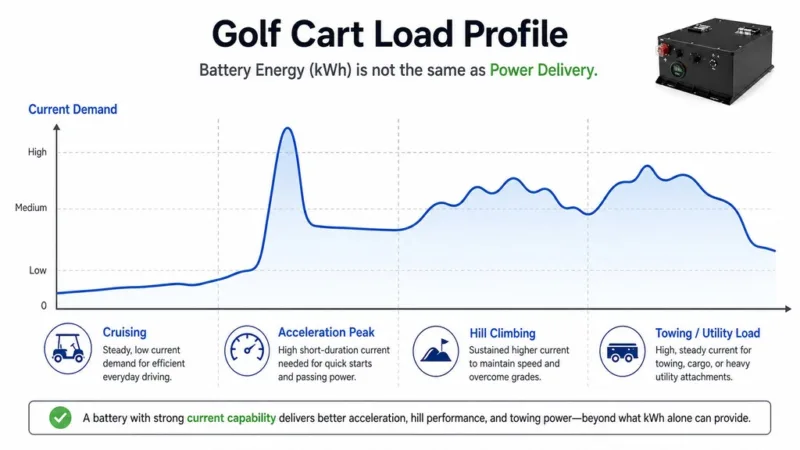
Kilowatt-hours show how much energy a battery stores. They do not show how much power the battery can deliver at one time. Two 51.2V 100Ah batteries may both store about 5.12kWh of nominal energy, but one may be suitable for a stock cart on flat ground while the other is designed for a lifted cart, heavier payload, high-current controller or repeated hill climbing.
A golf cart motor may demand high current during startup, acceleration, hill climbing, towing or frequent stop-start operation. If the battery is not designed for that current, the vehicle may experience excessive voltage sag, reduced power or unexpected BMS trips.
Higher current capability can require lower-resistance cells, thicker busbars, larger cables, stronger connectors, better heat management and a higher-current BMS. These parts increase cost even when voltage and amp-hours remain the same.
This is why buyers should not compare only the advertised capacity. A complete quotation should state continuous discharge current, peak discharge current and peak-current duration. A quotation that says only “300A peak” is incomplete because a one-second peak rating does not mean the same thing as a ten-second or thirty-second rating.
| BMS/current class | Suitable application | What to verify |
| 100A class | Stock golf carts on moderate terrain | Controller current, acceleration demand and peak current duration. |
| 150A class | Commercial replacement, fleet use and light utility carts | Continuous current margin, charger compatibility, SOC display and installation kit. |
| 200A+ or contactor-based | Lifted carts, upgraded controllers, towing, steep grades or OEM integration | Peak duration, cable size, connector rating, thermal design and communication needs. |
The Golf Cart Battery BMS Affects Both Price and Reliability
The golf cart battery BMS monitors the cells, controls charging and discharging, and protects the pack against unsafe operation. Most systems include basic protection against overcharge, over-discharge, overcurrent, short circuit and abnormal temperature. However, two BMS units with the same basic protection list can still differ significantly.
For a standard cart, a moderate-current MOSFET-based BMS may be enough. For more demanding vehicles, the battery may need a larger MOSFET system or a contactor-based architecture. Higher-current systems can require additional hardware, wiring, control logic and heat management.
BMS features also affect price. Bluetooth monitoring, CAN communication, RS485 communication, more accurate SOC calculation, low-temperature charge cutoff, better balancing and diagnostic data can all add cost. These features may be unnecessary for a simple private-use cart, but valuable for fleets, rental operations, dealers and OEM projects.
The right BMS is therefore not the one with the largest number printed on the quotation. It is the one that matches the vehicle controller, motor power, terrain, load, charger and service requirements.
Mechanical Design, Conductors and Accessories Change the Delivered Cost
A battery with similar cells and BMS ratings can still differ in total cost because of its mechanical design. Golf cart batteries may require a steel or aluminum enclosure, an IP-rated housing, vibration-resistant mounting, reinforced terminals, specific cable exits, fuses, contactors, handles, display ports or vehicle-specific brackets.
Conductors are especially important in high-current applications. Busbars, cables, connectors and terminals must be sized for the expected current and heat. If they are undersized, the battery may suffer from voltage drop, heat buildup or long-term reliability problems. A stronger current path costs more, but it can be necessary for lifted carts, heavy utility work, towing or steep-grade operation.
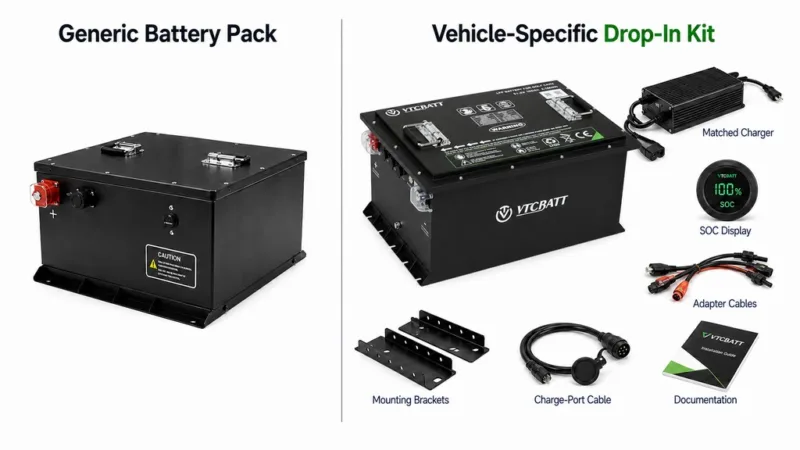
Accessories are another common reason for price differences. One quotation may include only the battery. Another may include a LiFePO4 charger, SOC display, adapter harness, charge-port cable, mounting hardware and communication setup. For a dealer or fleet operator, the second quotation may be more expensive upfront but easier to install and support.
This is especially important for drop-in replacement projects. A battery that does not match the compartment, terminals, cable direction, charger voltage or charge-port layout may require extra parts or labor. Buyers should compare the delivered and installed system, not only the battery-pack price.
Testing, Compliance and Warranty Are Part of the Real Price
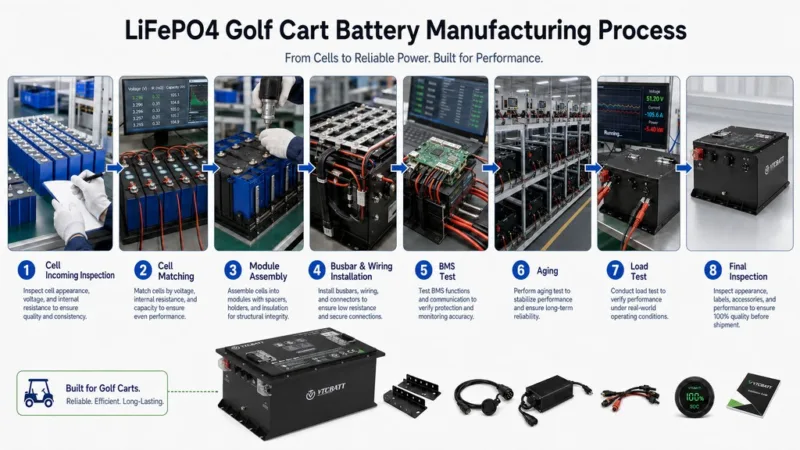
Testing is not always visible in product photos, but it affects both cost and risk. A more complete production process may include cell matching, assembly inspection, BMS function testing, capacity testing, load testing, aging, final inspection and test-record storage.
A lower-priced battery may still work well in the right application, but a quotation with limited test information gives the buyer less evidence. For distributors, fleet operators and OEM buyers, the value of test records is not only technical. Records also make after-sales diagnosis easier when a battery fails in the field.
Compliance and transport documents should also be confirmed before comparing quotes. Depending on the destination, sales channel and shipping method, buyers may need transport documents such as UN38.3-related records, safety data documents or dangerous-goods shipment support. Buyers should ask exactly which documents are included instead of assuming that every certificate applies to every market.
Warranty support also has a real cost. The question is not only how many years are printed on the warranty. Buyers should understand what is covered, what operating conditions are excluded, how faults are diagnosed, whether spare parts are available, how replacement batteries are handled and who pays for return shipping if a problem occurs.
Cheap vs Premium Golf Cart Lithium Battery: What Are Buyers Actually Paying For?
The phrase cheap vs premium golf cart lithium battery should be used carefully. A cheaper battery is not automatically unsafe, and a premium battery is not automatically the best choice. The useful comparison is configuration transparency.
An economy-oriented battery may be suitable for a standard golf cart on moderate terrain, especially when the buyer already has a compatible charger and does not need advanced communication or a vehicle-specific installation kit. This kind of battery may focus on basic function and keep accessories simple.
A premium-oriented battery may be justified when the cart has a high-current controller, larger tires, repeated steep-grade use, towing requirements, a heavy utility load or OEM integration needs. In these cases, the added cost may come from stronger current architecture, better thermal design, communication functions, custom housing, deeper validation and more complete support.
The main question is not whether the battery is cheap or premium. The main question is whether the design is appropriate for the vehicle and whether the supplier explains the configuration clearly.
| Item | Economy-oriented battery | Premium-oriented battery |
| Best fit | Standard cart, moderate terrain and budget-sensitive replacement | Commercial, utility, high-power or OEM-integrated vehicle |
| Cells | May have limited documentation or simpler matching records | Clearer model, batch traceability and test records |
| BMS/current | Basic protection and moderate current rating | Higher continuous current, defined peak duration and optional diagnostics |
| Accessories | Battery-only or limited accessories | Matched charger, SOC display, harness, brackets or drop-in kit may be included |
| Testing | Basic final inspection | Capacity, load, BMS and aging records may be available |
| Support | Limited documentation and diagnostic support | More complete warranty process and engineering support |
Example: Three 48V 100Ah Golf Cart Battery Quotations
A practical way to understand price variation is to compare three possible 48V or 51.2V 100Ah quotations. These examples are not fixed market prices. They show how included components and intended use can change the quotation.
Quotation A is an economy configuration. It may include a basic BMS, standard enclosure, limited accessories and basic final inspection. It can be suitable for a stock cart on moderate terrain when the buyer already has compatible installation parts and does not need advanced monitoring or communication.
Quotation B is a standard commercial configuration. It may include traceable cells, a 150A-class BMS, a matched charger, an SOC display and clearer test records. For many dealers, fleets and rental users, this level offers a practical balance between cost, installation convenience and support.
Quotation C is a high-power OEM configuration. It may include a stronger current architecture, larger conductors, communication functions, custom housing and deeper validation. It is more suitable for high-current controllers, lifted carts, utility work, steep grades, towing or OEM-integrated vehicles.
The highest-priced option is not always necessary. A standard low-power cart may not need CAN communication, a contactor-based architecture or a custom enclosure. At the same time, the lowest-cost option may not be the best value if the vehicle requires a charger, display, stronger current output or better installation compatibility.
| Quotation | Positioning | Typical configuration | When it makes sense |
| A: Economy | Basic replacement pack | Basic BMS, standard enclosure, limited accessories and basic inspection | Stock cart, moderate terrain, buyer already has compatible charger and installation parts |
| B: Commercial | Balanced fleet or dealer option | Traceable cells, 150A-class BMS, matched charger, SOC display and clearer test records | Dealers, fleets and rental use that need predictable installation and support |
| C: High-power OEM | Demanding or integrated system | Higher-current architecture, stronger conductors, communication, custom housing and deeper validation | High-current controller, lifted cart, utility work, steep grades, towing or OEM integration |
What Buyers Should Provide Before Requesting a Quotation
A supplier can only recommend the right battery when the vehicle information is clear. Buyers should provide the golf cart brand and model, original system voltage, target range, battery-compartment dimensions, motor-controller model, maximum controller current, motor power, terrain, payload, passenger count, towing requirement, existing charger and charge port, connector type, communication needs, destination market and expected annual quantity.
This information helps the supplier avoid recommending a battery based only on voltage and capacity. It also helps separate necessary cost from optional features. A capable LiFePO4 golf cart battery manufacturer should use these details to match the pack design to the real vehicle demand. A good golf cart lithium battery buying guide should lead buyers toward specification-based comparison instead of simple price sorting.
FAQ
Why are golf cart lithium batteries so expensive?
Golf cart lithium batteries are expensive because they use many high-quality LiFePO4 cells, a high-current BMS, a durable enclosure, heavy-duty cables, a compatible charger, and strict testing. The price also includes safety certification, warranty, and technical support.
How much should a 48V golf cart lithium battery cost?
A 48V golf cart lithium battery typically costs:
- 48V 50–60Ah: US$400–650
- 48V 100–105Ah: US$600–1,000
- Shipping: US$100–400+, depending on destination and quantity
- Certification: UN38.3, MSDS, CE, and other required documents may add to the cost
The final price depends on the cells, BMS, charger, enclosure, testing, shipping method, and certification requirements.
Is a 100Ah battery enough for a golf cart?
Yes. A 100Ah lithium battery is enough for most golf carts.
- Typical range: 40–60 miles per charge
- Suitable for: daily driving, golf courses, communities, and light commercial use
- Actual range depends on vehicle weight, speed, terrain, tire size, motor power, and passenger load
- For steep hills, heavy loads, or longer routes, consider 150Ah or higher
What BMS current rating does a golf cart need?
- Standard golf cart: 100–150A continuous BMS
- Hills or heavy loads: 150–200A continuous
- Modified/high-power cart: 200–300A continuous
- Peak current: usually 2–3× the continuous rating for a few seconds
For most 48V 100Ah golf cart batteries, a 150A continuous BMS with 300–400A peak current is suitable.
Are cheaper LiFePO4 golf cart batteries safe?
Cheaper LiFePO4 golf cart batteries can be safe, but price alone is not enough.
Check for:
- Grade-A cells and traceable batches
- Correct BMS current rating
- Overcharge, over-discharge, temperature, and short-circuit protection
- UN38.3, MSDS, CE, or required market certifications
- Proper enclosure, wiring, insulation, and testing
- Clear warranty and technical support
Avoid batteries with unclear cell brands, exaggerated capacity, weak BMS specifications, or no test documents.
Does a lithium golf cart battery need a special charger?
Yes. A lithium golf cart battery should use a lithium-compatible charger.
Check that the charger matches:
- Battery chemistry: LiFePO4
- Pack voltage: 36V, 48V, 72V, etc.
- Required charging voltage
- Recommended charging current
- Connector and communication requirements
Do not use a lead-acid charger unless the battery manufacturer confirms compatibility.
What is the difference between 48V and 51.2V golf cart batteries?
- 48V is the golf cart system class.
- 51.2V is the actual nominal voltage of a 16-cell LiFePO4 battery: 16 × 3.2V.
- Fully charged voltage is usually 58.4V.
- Most 48V golf carts can use a 51.2V LiFePO4 battery.
- The charger, controller, motor, and accessories must support the battery’s voltage range.
How long does a LiFePO4 golf cart battery last?
A LiFePO4 golf cart battery typically lasts:
- 3,000–6,000 charge cycles
- About 8–12 years under normal use
- Longer with proper charging, moderate temperatures, and limited deep discharge
Actual life depends on cell quality, BMS design, usage, load, temperature, and charging habits.
What information is needed for a custom golf cart battery quotation?
For a custom golf cart battery quotation, provide:
- Golf cart brand and model
- Battery voltage and capacity
- Required driving range
- Motor power and controller current
- Continuous and peak discharge current
- Battery-compartment dimensions
- Charger and connector requirements
- Bluetooth, CAN, display, or heating functions
- Certification and destination market
- Sample and annual order quantity
Conclusion: Compare Engineering Specifications, Not Only Voltage and Amp-Hours
Golf cart lithium battery cost varies because the battery is a complete engineered system. Voltage and amp-hours are only the starting point. Cells, verified capacity, discharge current, BMS architecture, mechanical design, accessories, testing, documents and after-sales support all affect the final quotation.
The right battery is not always the cheapest or the most expensive. It is the configuration that meets the real vehicle demand without unnecessary features or hidden installation cost. To receive a suitable VTCBATT battery configuration, provide the vehicle model, system voltage, required driving range, controller current, available battery-space dimensions, destination market and expected order quantity.
VTCBATT recommends using Grade-A cells, although they do not necessarily have to come from first-tier cell brands. The BMS should not be chosen casually. It monitors and controls each cell in the battery pack, balances voltage distribution, protects the system from overcharge, short circuit and overheating, and may also provide communication functions. VTCBATT engineers can quickly provide an accurate battery solution based on your project requirements. Cold-weather starting can also affect normal battery operation and long-term service life, so the budget should properly account for both the BMS and the cells. Since the main purpose of choosing a lithium battery is to achieve a long service life of up to 10 years or more and very low maintenance cost, buyers should consider increasing the cost budget for a more reliable configuration. The final battery voltage, capacity and instant output current should be selected according to the vehicle requirements, including speed, road conditions, payload, charging frequency and other operating demands.


