

Introduction
Many golf cart users upgrade to lithium batteries for longer range, lighter weight, faster charging and better performance. After the upgrade, one of the most common questions is whether existing headlights, USB chargers, audio systems, cooling fans and other 48V golf cart accessories can continue working safely.
The answer depends on the golf cart 12V accessory wiring, the original battery voltage, the built-in DC-DC converter or voltage reducer, and the current demand of each accessory. In most lithium golf cart electrical systems, the main battery pack powers the motor controller, while a separate 12V accessory circuit powers lights, USB ports and electronics.
1. Understanding Golf Cart Electrical Systems Before Adding Accessories
Before adding new accessories or upgrading to a lithium battery, it is important to understand that a golf cart usually has two different electrical systems: the main power system and the accessory power system.
Main Power System
The main power system provides energy for vehicle movement. It includes:
- Battery pack
- Motor controller
- Drive motor
Most golf carts use:
- 36V systems
- 48V systems
- 72V systems
This circuit handles high current to support acceleration, climbing, and overall vehicle performance.
Accessory Power System
The accessory power system supplies low-voltage power for additional electronics, including:
- LED lights
- USB chargers
- Audio systems
- Cooling fans
- Decorative lighting
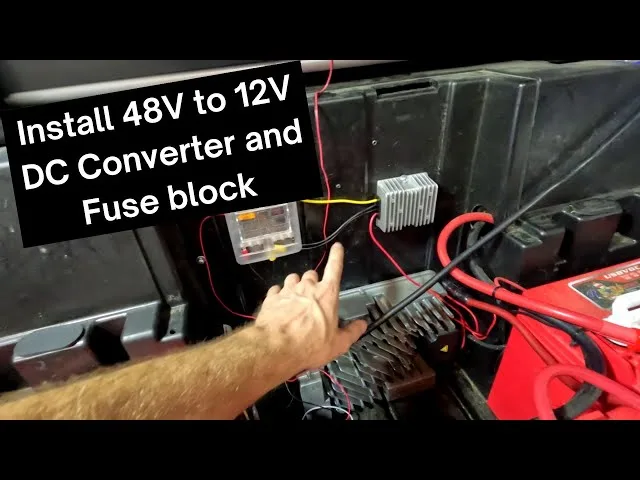
Most accessories operate on 12V DC power. Since the main battery voltage is much higher, golf carts typically use a DC-DC converter, also called a golf cart voltage reducer, to convert 36V, 48V or 72V battery power into stable 12V output. For a common 48V lithium conversion, this part is often described as a 48V to 12V converter for golf cart accessories.
Existing accessories may continue working if the original converter is compatible with the new LiFePO4 golf cart battery upgrade, but the input voltage range, output amperage, fuse protection and wiring condition should always be checked first.
2. Does a Golf Cart Already Have a Built-in Voltage Converter?
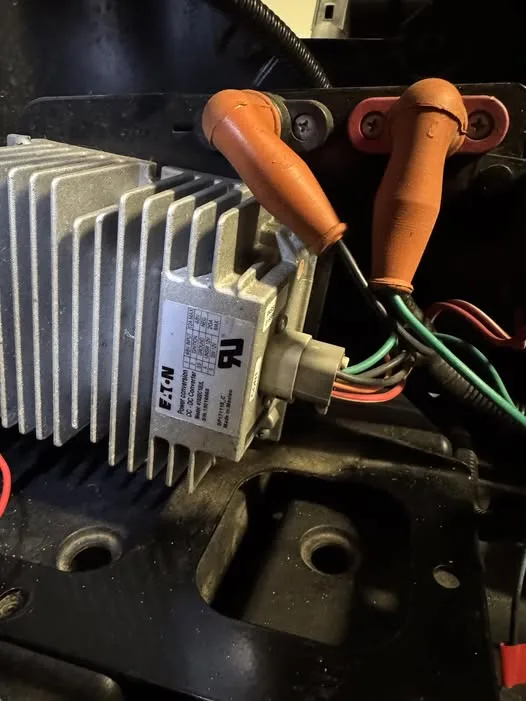
Many golf carts already include a DC-DC converter or voltage reducer. It converts high battery voltage, such as 36V, 48V or 72V, into 12V power for accessories. If the cart already has factory LED headlights, taillights, USB chargers, speakers, turn signals or cooling fans, it may already have a built-in converter or accessory power module.
To confirm, inspect the factory harness, accessory fuse panel or converter label. Look for markings such as input voltage, output voltage, output current and wiring polarity. A label showing 48V input and 12V output usually means the cart has a voltage reducer, but it still needs to support the full charge voltage of the lithium battery pack.
3. Can You Reuse the Existing Converter After Installing a Lithium Battery?
Yes, in many cases. However, three conditions should be checked before reusing the existing golf cart DC converter:
1. Input voltage range:
The converter must support the lithium battery voltage range. For example, a 48V LiFePO4 battery usually has 51.2V nominal voltage and about 58.4V full charge voltage. A converter rated only for a narrow lead-acid voltage range may shut down, overheat or fail.
2. Output current capacity:
Small converters may support USB chargers and LED lights only. Larger accessory loads, such as audio amplifiers, fans, light bars, heaters, air conditioning controls or winches, may require a higher-current converter.
3. Wiring and connection:
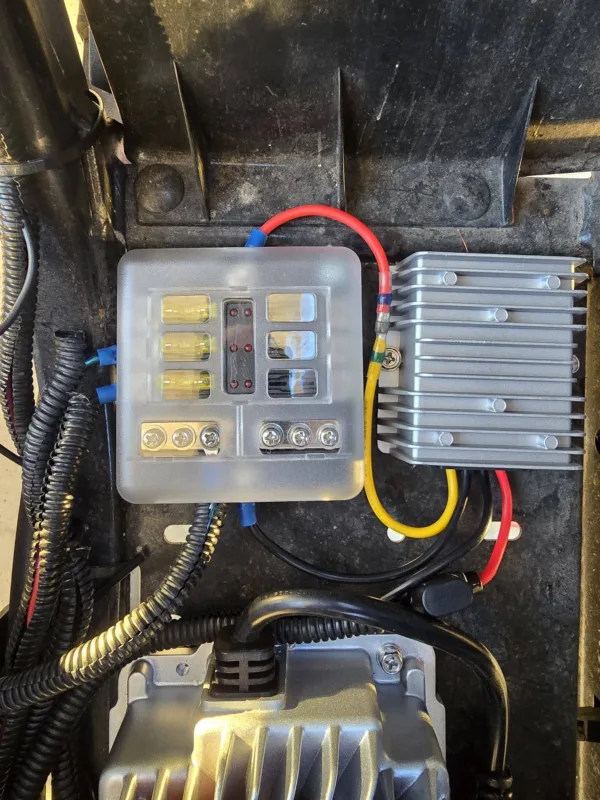
Check positive and negative terminals, fuse protection, connector quality, cable size and waterproofing. The safest accessory wiring uses a fused 12V distribution point instead of random taps into the battery pack.
4. Common Golf Cart Accessories and Power Requirements
USB Charger:
– Usually provides 5V output from a 12V input module
– Low current draw, but should still be fused
LED Lights:
– Usually 12V
– Includes headlights, taillights, turn signals and decorative lighting
– Stable 12V output helps prevent flicker and premature failure
Bluetooth Speakers / Stereo:
– Usually 12V
– Current demand depends on amplifier size and volume
Cooling Fans:
– Usually 12V or 24V
– Confirm motor voltage before connection
Air Conditioner or Heater Controls:
– Higher power requirement
– May require a dedicated converter, relay or direct battery-side power design
Winch:
– High current accessory
– Usually requires a dedicated wiring plan, heavy cable, proper fusing and professional installation
5. When Do You Need a New DC-DC Converter?
Replace the converter when:
– The voltage range does not match the lithium battery
– Existing converter has insufficient output current
– Many new accessories are added
– High-power devices such as air conditioning, heaters, amplifiers or winches are installed
– The converter runs hot, causes light flicker or shuts down under load
– The existing wiring has no fuse, poor connectors, undersized cable or corrosion
For a 48V golf cart accessories setup, choosing a properly rated 48V to 12V converter for golf cart use is usually safer than relying on an unknown old reducer.
6. Golf Cart Model Differences: Factory Voltage Reducer and Lithium Upgrade Compatibility
Golf cart accessory wiring depends heavily on the vehicle model, production year and equipment package. Some newer golf carts include a factory-installed DC-DC converter, while many older models require an external voltage reducer when adding 12V accessories.
Before connecting accessories after a lithium battery upgrade, always check whether the vehicle already has a 36V/48V-to-12V converter, whether it supports LiFePO4 full-charge voltage, and whether its output current is enough for the planned accessory load.
Club Car
Club Car DS (1981–2014)
Factory converter: Usually No (for standard models)
Older Club Car DS electric models were mainly designed around the main battery pack and motor controller.
For adding 12V accessories:
- LED lights
- USB charger
- stereo
an external voltage reducer is commonly required.
After lithium conversion:
Recommended setup:
48V LiFePO4 Battery–>48V-12V DC Converter–>Lights / USB / Audio
Club Car Precedent (2004–Present)
Factory converter: Depends on configuration
Many Precedent models with factory lighting/accessory packages include a voltage reducer or accessory power module.
Before reuse:
Check:
Converter input range
- Output current
- Connection location
A common lithium upgrade solution:
- Keep original converter if rated for 48V lithium voltage
- Replace with higher-current converter if adding more accessories
Club Car Onward / Tempo
Factory converter: Usually equipped on accessory-equipped vehicles
These newer models often have factory accessory systems.
However:
A standard cart without factory accessories may not include a converter.
Check:
- Factory harness
- Accessory fuse panel
- DC converter label
EZGO
EZGO TXT
Factory converter: Usually No on older TXT models
Common versions:
- 36V TXT
- 48V TXT
Older TXT carts normally require:
- external voltage reducer
for:
- headlights
- USB chargers
- radios
After lithium conversion:
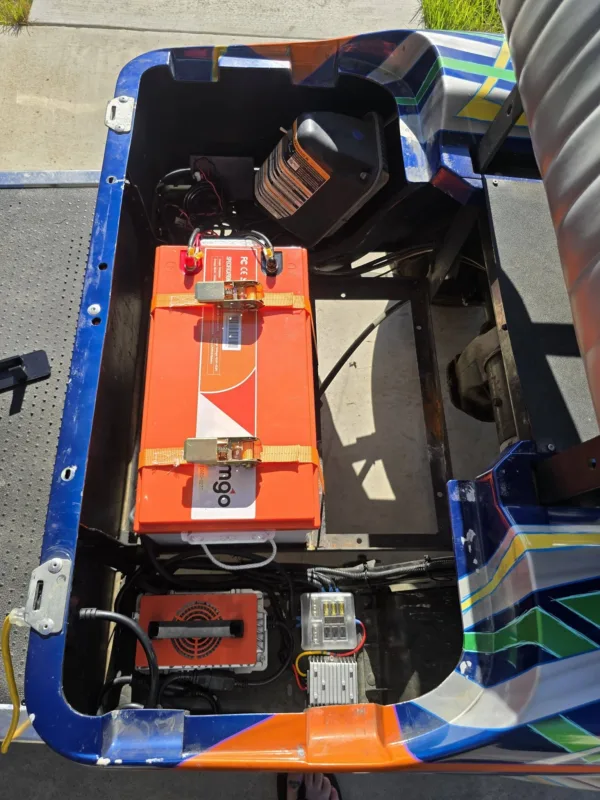
A dedicated 48V-to-12V converter is normally recommended.
EZGO RXV
Factory converter: Usually Yes on many 48V RXV configurations
RXV uses a more integrated electrical architecture.
Many RXV carts have:
- factory accessory power system
- voltage reduction module
After lithium conversion:
The original converter can often remain if:
Input voltage supports:
- 48V lead acid system
- 51.2V LiFePO4 system
Need to verify:
- converter model
- voltage range
- output current
EZGO Valor / Express / Liberty
Factory converter: Depends on equipment package
Utility and street-legal versions are more likely to include:
- lighting systems
- accessory modules
- DC converters
Basic fleet models may not.
Yamaha
Yamaha G-Series (G8/G9/G14/G16/G19/G22)
Factory converter: Usually No
Older Yamaha electric carts generally require an external voltage reducer for 12V accessories.
Yamaha G29 / Drive
Factory converter: Depends on model and accessories
Many newer Drive models with factory accessories include a DC-DC converter.
When converting to lithium:
Check:
- converter input voltage
- output rating
Yamaha Drive2
Factory converter: Commonly equipped on accessory models
Drive2 models with:
- headlights
- turn signals
- street package
usually have a 12V accessory power system.
7. Quick Reference Table
| Model | Factory DC-DC Converter | Lithium Upgrade Recommendation |
| Club Car DS | Usually No | Add a properly fused 48V to 12V converter for golf cart accessories |
| Club Car Precedent | Depends on package | Check and reuse if compatible |
| Club Car Onward | Common on accessory models | Verify converter rating |
| EZGO TXT | Usually No | Add external golf cart voltage reducer |
| EZGO RXV | Often Yes | Usually check and reuse |
| EZGO Express | Depends | Verify accessory system |
| Yamaha G-Series | Usually No | Add external voltage reducer and new accessory wiring if needed |
| Yamaha Drive | Depends | Check existing converter |
| Yamaha Drive2 | Common on equipped models | Verify voltage range |
8. Installation Tools and Professional Wiring
Recommended tools:
– Multimeter
– Wire stripper
– Crimping tool
– Heat shrink tubing
– Fuse holder
– Waterproof connectors
– Correct-gauge cable
– 12V accessory fuse block when multiple devices are installed
Professional installation:
– Hidden cable routing
– Wire sleeves
– OEM-style harness
– Proper fuse and relay protection
– Waterproof connectors for outdoor use
– Clear separation between high-voltage battery wiring and 12V accessory wiring
Important safety note: Always disconnect the battery before wiring, verify polarity with a multimeter, and confirm the converter rating before applying power. If the cart has unknown wiring, damaged connectors or high-current accessories, ask a qualified technician to inspect the system.
9. VTCBATT Lithium Battery Customization and Complete Accessory Kits
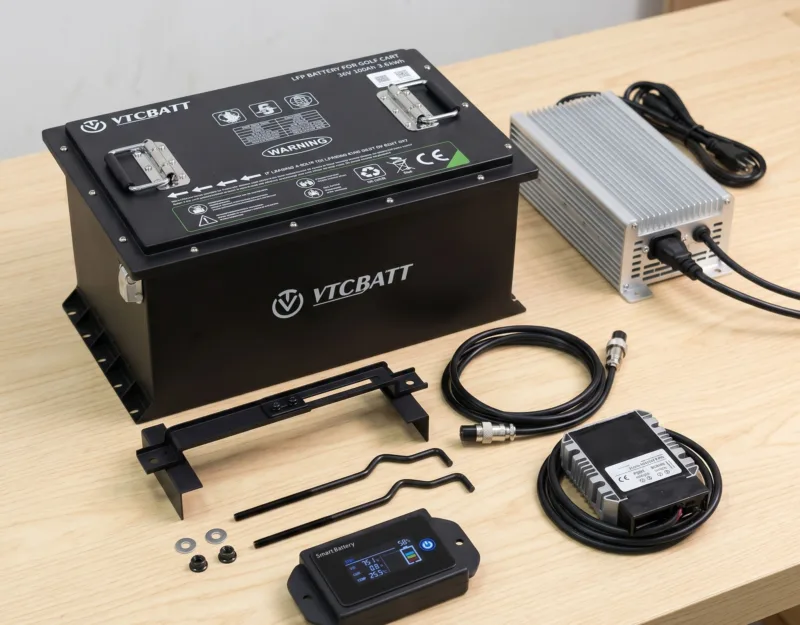
VTCBATT provides custom lithium battery solutions for golf carts and other electric vehicles, including LiFePO4 battery packs matched to 36V, 48V and 72V systems. For projects that need more than a battery replacement, VTCBATT can also support complete kits with compatible DC-DC converters, voltage reducers, chargers, wiring accessories, connectors and related components.
If you are planning a LiFePO4 golf cart battery upgrade and need to keep lights, USB chargers, audio systems, fans or other electronics working correctly, VTCBATT can help review voltage, capacity, discharge current, converter output and accessory load requirements. Custom battery design, accessory matching and technical consultation are welcome.
FAQ
Q: Do I need a voltage reducer after installing a lithium golf cart battery?
A: Not always. If your cart already has a DC-DC converter and the converter supports the lithium battery’s full voltage range, you may be able to reuse it. For example, a 48V LiFePO4 pack can reach about 58.4V when fully charged, so the converter must tolerate that voltage, not just the nominal 48V rating. You should also confirm that the output current is high enough for all lights, USB chargers, speakers and other accessories operating at the same time.
Q: Can I connect a USB charger directly to a 48V lithium battery?
A: No. Most USB charger modules are designed for 12V input, then convert that to 5V USB output. Connecting a 12V USB charger directly to a 48V lithium battery can destroy the charger and may create a safety risk. Use a properly rated 48V to 12V converter for golf cart accessory wiring, then connect the USB charger to the 12V side with fuse protection.
Q: Can I keep my original lights after lithium conversion?
A: In many cases, yes. Original LED or halogen lights can usually stay if they are powered through a compatible 12V accessory circuit. The key is to check whether the existing converter supports the new lithium battery voltage and whether the wiring is protected by fuses. If lights flicker, dim, burn out or turn off under load, the converter may be undersized or incompatible.
Q: How do I know what size DC-DC converter I need?
A: Add the current draw of all accessories that may run at the same time, then choose a converter with a reasonable safety margin. For example, if lights, USB ports, a stereo and fans draw 18A total, a 20A converter is too close to the limit. A 30A or higher rated converter may be more appropriate depending on cable length, heat, enclosure ventilation and future accessories.
Q: Is a 48V golf cart accessory system the same after switching from lead acid to LiFePO4?
A: Not exactly. The nominal system voltage may still be called 48V, but lithium batteries have a different voltage curve and a higher full-charge voltage than lead-acid batteries. That is why the lithium golf cart electrical system should be checked as a complete system, including the battery, BMS, charger, converter, controller and accessory wiring.
Q: What are the most common wiring mistakes after a LiFePO4 golf cart battery upgrade?
A: Common mistakes include connecting 12V accessories directly to one part of the battery pack, skipping fuse protection, using undersized cable, reversing polarity, reusing a converter with the wrong input range, and adding high-current accessories without calculating total load. These issues can cause overheating, unstable accessory performance or component failure.
Q: Should high-current accessories such as a winch or air conditioner use the same converter as lights and USB chargers?
A: Usually no. High-current accessories may need a dedicated wiring design, separate fuse protection, relays, thicker cables or a dedicated converter. Combining a winch, amplifier or air-conditioning load with small 12V electronics can overload the accessory circuit and cause voltage drops.
Q: When should I ask for technical support instead of doing the wiring myself?
A: Ask for technical support if you do not know the cart’s battery voltage, cannot identify the converter label, see damaged or modified wiring, plan to install high-current accessories, or want a clean OEM-style harness. A supplier such as VTCBATT can help match the lithium battery, golf cart DC converter, charger and accessory kit to the actual cart model and usage requirements.


