
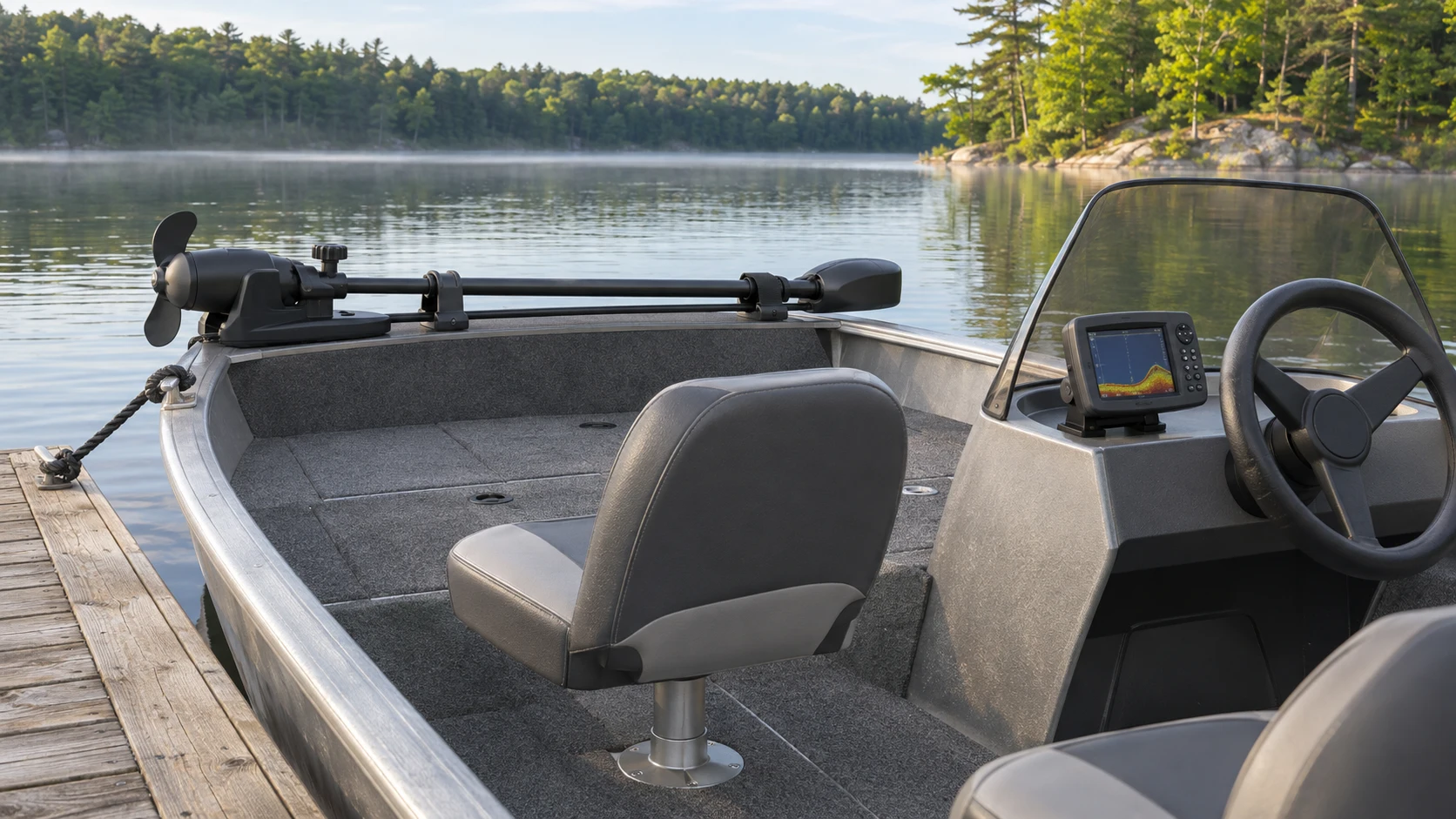
The example below puts a 12V trolling motor, a fish finder, and a deck light on the same battery. You can run the same calculation with your own equipment and fishing time, then check whether the batteries on your shortlist can handle the motor, fit the tray, and work with your charger.
Start by listing the devices powered by the same battery. Illustrative image.
What runs on your 12V battery?
Start at the battery you plan to replace. If your trolling motor has a dedicated battery, count the motor alone. If the fish finder and lights run from that battery too, add them to the list. Count equipment on a separate house battery in its own budget. Check the outboard’s starting battery separately against the engine manufacturer’s requirements.
Write down two figures for the trolling motor. The first is its maximum draw, which you can find in the manual. You’ll use it to check whether the battery can deliver enough current. The second is the average draw while the motor is in use, which you’ll use to estimate capacity. If you have a battery monitor that tracks amps or amp-hours, a trip on your usual water gives you a starting point. When the monitor measures the whole battery, its trip total already includes every device on that battery. A motor manufacturer’s wiring guide can help you locate the maximum-current specification for your model. Minn Kota trolling motor battery and wiring guide
How many amp-hours will your trip use?
Multiply each device’s average current while it runs by the number of hours it’s on. The result is that device’s amp-hour use. A light drawing 1A for two hours uses 2Ah. If a DC device lists watts, divide its power draw by the operating voltage to estimate current. For an AC device on an inverter, measure or estimate power on the battery side so the budget includes inverter losses.
Table 1. A four-hour load budget
| Device | Average draw while on | Hours on | Capacity used |
| Trolling motor | 18 A | 3 h | 54 Ah |
| Fish finder | 1 A | 4 h | 4 Ah |
| Deck light | 1 A | 2 h | 2 Ah |
| Trip total | 15 A over the trip | 4 h elapsed | 60 Ah |
The currents and operating times are assumptions. The motor averages 18A during three hours of use, and the fish finder stays on for the full four hours. The light can run while the other devices are on, so their operating hours overlap. Add the amp-hours: 54 + 4 + 2 = 60Ah. Spread across the four-hour trip, that equals an average battery draw of 15A.
The motor accounts for 54 of the 60Ah. If you spend an extra half hour on the motor at the same average draw, it adds 9Ah. Try that longer scenario, or use a trip on a windy day, before choosing a battery based on your usual outing.
How much capacity should you leave in reserve?
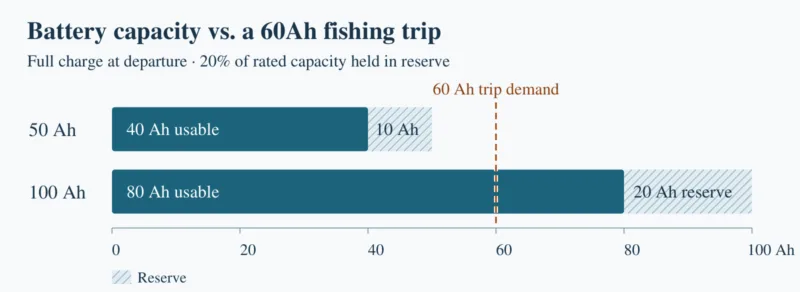
For this example, plan to use up to 80% of rated capacity and keep 20% in reserve. Starting with a fully charged battery, divide the expected trip use by the fraction you plan to use.
Minimum rated capacity = 60Ah ÷ 0.80 = 75Ah
Use that 75Ah figure to screen batteries for the trip. Your reserve depends on how much your load can vary and how much charge you want left when you return. The 20% used here is a planning assumption. Check your chosen battery’s recommended discharge depth and operating temperatures. If those limits, battery age, or a partial starting charge reduce the capacity you can count on, adjust the budget before you shop.
In this example, the 100Ah battery covers the trip and keeps the planned reserve.
Should you choose 50Ah or 100Ah?
A 50Ah battery can be a candidate for shorter trips or lighter loads. With the same reserve, it lets you budget 40Ah. At a trip average of 15A, a two-hour outing uses 30Ah and leaves 10Ah of that budget unused. If you’re considering the VTCBATT 12V 50Ah VTC-4F50, apply that calculation to your own trip, then compare your motor’s current requirements with the product specifications.
For the four-hour outing, a 12V 100Ah marine battery gives you an 80Ah planned budget. After using 60Ah, you have 20Ah of trip budget left, plus the 20Ah reserve. The VTCBATT 12V 100Ah LiFePO4 battery lists boats and trolling motors among its applications. Check the specific battery against your motor and installation before ordering.
Table 2. What 50Ah and 100Ah cover at a 15A average draw
| Rated capacity | Planned usable capacity | Estimated runtime to reserve | Four-hour trip |
| 50 Ah | 40 Ah | 2 h 40 min | 20 Ah short |
| 100 Ah | 80 Ah | 5 h 20 min | 20 Ah left in the trip budget |
These estimates assume a full charge at departure and a 20% reserve. Divide planned usable capacity by average draw to get runtime. Real runtime varies with load, temperature, and battery condition. Before you buy, measure the inside of the tray and clearance above the terminals. Check the battery weight against the tray and mounting hardware, and confirm that the cables reach the posts with the battery secured in place.
Will it handle your motor and charger?
When choosing a battery for a 12V trolling motor, check the motor’s voltage requirements and maximum draw. Add any loads that can run at the same time, then compare that total with the battery’s continuous discharge rating and the limits of its battery management system (BMS). The 18A average in the example is for the runtime calculation. When the motor runs at full power, its draw can be much higher.
For example, VTCBATT specifies a 50A maximum continuous discharge current for the VTC-4F50. Its recommended charging voltage is 14.6V, and its recommended charging current is 2.5–25A. Those are model-specific figures. If you choose a different 12V lithium deep cycle battery, check that model’s charging profile, current, and temperature limits before reusing the charger. VTC-4F50 charging and discharging specifications
Frequently asked questions
How long will a 100Ah battery last at 20A?
With 80Ah available under the same reserve assumption, it would run for about four hours at an average draw of 20A. If the motor draws 20A and your electronics add another 2A throughout the trip, use 22A and the estimate drops to about 3 hours 38 minutes.
Can I use this battery to start my outboard?
Check the outboard manual for the required starting rating and match it to an explicit starting rating from the battery manufacturer. The amp-hour rating describes capacity. For engine starting, you also need a battery approved for the engine’s cranking and charging requirements.
Take your motor model, estimated average draw, trip length, and tray measurements with you when you compare configurations. Explore VTCBATT 12V deep cycle marine batteries.


