
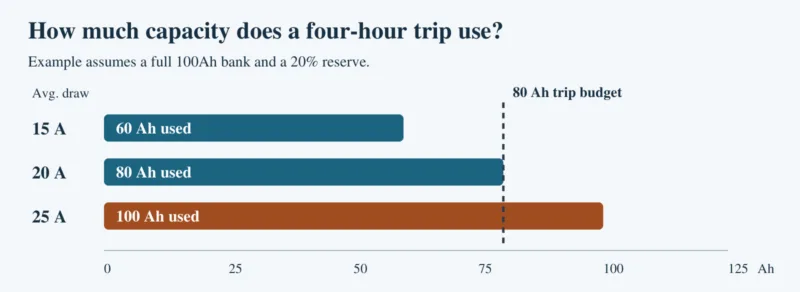
Here’s how to compare the layouts using a four-hour fishing trip. At an average draw of 20A across those four hours, a 100Ah battery bank gives you the 80Ah needed for the trip and leaves 20Ah in reserve under the assumptions below.
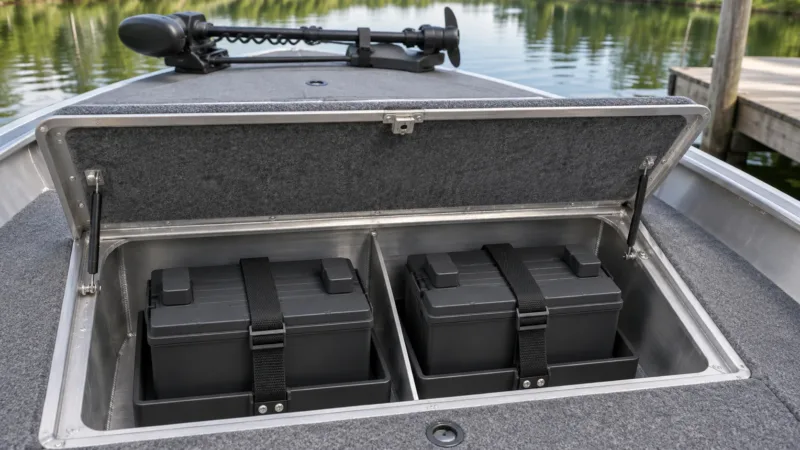
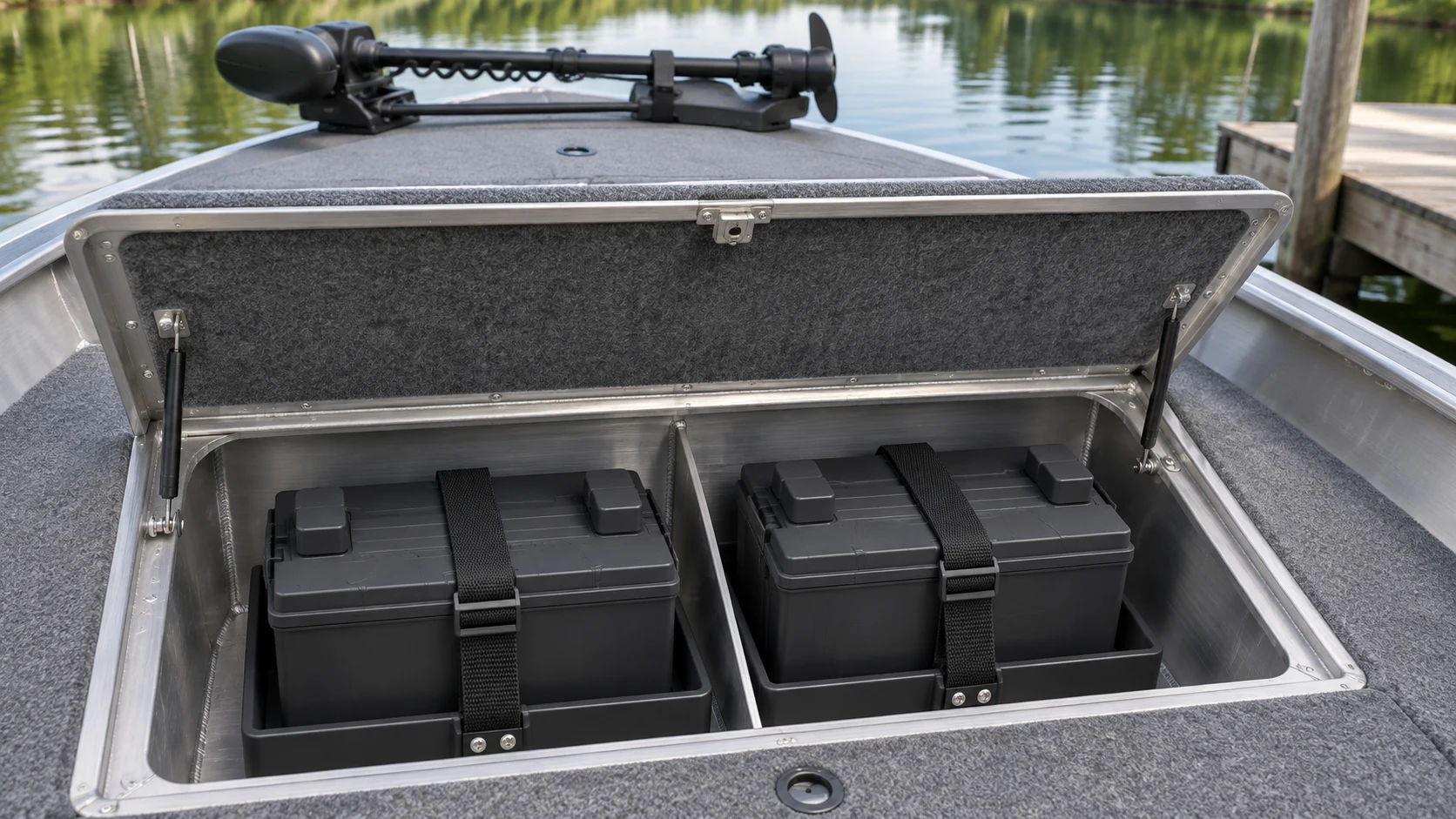
Measure both trays and the clearance above each battery. Illustrative image.
What does your 24V motor actually require?
Look up your exact motor model before choosing a 24V marine battery. Find its rated supply voltage and maximum current draw. For lithium, check whether the motor manufacturer permits the chemistry and whether the battery’s operating range and fully charged voltage fit the motor’s input limits. Ask the motor manufacturer if your manual gives a nominal voltage but leaves the upper limit unclear.
Use the motor’s maximum draw to check the battery and its battery management system, or BMS. Look for the continuous discharge rating. A short peak rating tells you how much current the battery can supply briefly. If the same bank powers any other equipment that can run while the motor is at full output, account for those loads as well. Motor manufacturers also publish model-specific protection and wiring guidance. Minn Kota trolling motor battery and wiring guide
One battery or two in series?
A single 24V-class pack gives you one case to mount and eliminates the connections between separate batteries. Check the weight of the whole pack and how you’ll lift it through the hatch. A pair of 12V modules gives you two cases to handle and can make use of two existing trays. If the trays sit in different compartments, include the space and routing for connections in your measurement.
In series, the battery voltages add and the amp-hour rating stays at that of one matched battery. Two 12V 100Ah modules in series give you a 24V-class, 100Ah bank. Both modules carry the full motor current, so each one needs to meet the discharge requirement. The 24V label describes the system class. Use the actual battery and motor specifications for voltage compatibility.
Table 1. Two ways to build a 24V trolling motor battery bank
| Decision point | One 24V-class pack | Two 12V 100Ah modules in series |
| Space | One tray sized to the selected pack | Two trays with clearance for each module |
| Rated capacity | Check the selected pack | 100Ah for the matched pair |
| Handling | Lift the full pack at once | Move one module at a time |
| Charging | Match the whole pack’s charge profile | Check approved whole-bank or isolated per-battery charging |
VTCBATT lists support for up to four identical modules in series for its 12V 100Ah LiFePO4 battery, with matching requirements for model, voltage, capacity, BMS type, and purchase timing. That makes two matched units a configuration to evaluate. Confirm the motor’s input limits, the battery’s discharge rating, and the charging method for your specific boat. VTCBATT 12V 100Ah LiFePO4 battery and series requirements
How much capacity does a four-hour trip take?
Estimate the motor’s average current across the trip, including periods when it is off. If your monitor measures total amp-hours drawn from a dedicated motor battery, use that trip total directly. It’s worth looking at both a calm outing and a trip where you fought a headwind or held position in current.
For a four-hour trip at 20A average draw, multiply 20A by four hours to get 80Ah. Suppose you want to keep 20% of rated capacity in reserve and start each trip fully charged. Divide 80Ah by 0.80 to get 100Ah of rated capacity. The reserve is a planning choice. Check whether the selected battery’s usable capacity under your conditions supports it.
Table 2. Battery capacity for four hours of fishing
| Assumed average draw | Capacity used in 4 h | Rated capacity with 20% reserve |
| 15 A | 60 Ah | 75 Ah |
| 20 A | 80 Ah | 100 Ah |
| 25 A | 100 Ah | 125 Ah |
At a 25A average draw, an 80Ah trip budget lasts about 3 hours and 12 minutes.
If you typically fish for four hours in calm conditions, the 20A row may be close to your measured average. A battery monitor that logs amp-hours gives you a way to validate the estimate. Write down the starting and ending readings, the trip length, and the wind conditions. If 25A is closer to what you see on exposed water, a 100Ah bank reaches the planned reserve before the trip ends. The table assumes the trolling motor is the only load. Add the electronics to your trip total if they share that bank.
What should you measure before ordering?
Measure the inside of each battery tray and the height below the closed hatch. Include room for the terminals, covers, and cable bends. Look at where the posts sit relative to the existing leads, and check the weight limits of the tray and mounting hardware. A pack can fit the compartment on paper while leaving too little room to secure it or service the connections.
Then read the charger label. If you want to keep your existing charger, verify each output’s voltage, current, and charge profile against the battery requirements. A native 24V pack calls for a charger that matches the whole pack. With two 12V modules, the approved options depend on the battery and charger manuals. Keep the model numbers handy when you compare options.
What changes with a 36V motor?
Three matching, series-approved 12V 100Ah modules form a 36V-class bank that still has a 100Ah rating. A native 36V pack is another option if it fits the motor’s specifications. Either move changes the charging requirements and may change the space you need. Check your 36V motor manual for its voltage and maximum current, then recalculate capacity with its own average draw. Minn Kota series configuration guidance
Frequently asked questions
Will two 12V batteries in series double my runtime?
A matched series pair has twice the nominal energy of one module and the same amp-hour rating. Runtime depends on the motor and the average load it draws at its rated voltage. For two alternative 24V banks powering the same motor, compare their usable amp-hours under the same conditions.
Can I reuse two older batteries?
Check the manufacturer’s requirements for matching modules and consider their condition. On the VTCBATT 12V 100Ah product page, series use calls for identical modules with matching electrical characteristics and purchase dates within six months. Ask the manufacturer to confirm the pair if either battery’s history is unclear. VTCBATT series connection guidance
When you’re ready to compare configurations, bring the motor model, expected trip length, average draw, tray measurements, and charger model. Those five details tell you whether a candidate fits both the boat and the way you fish.


