
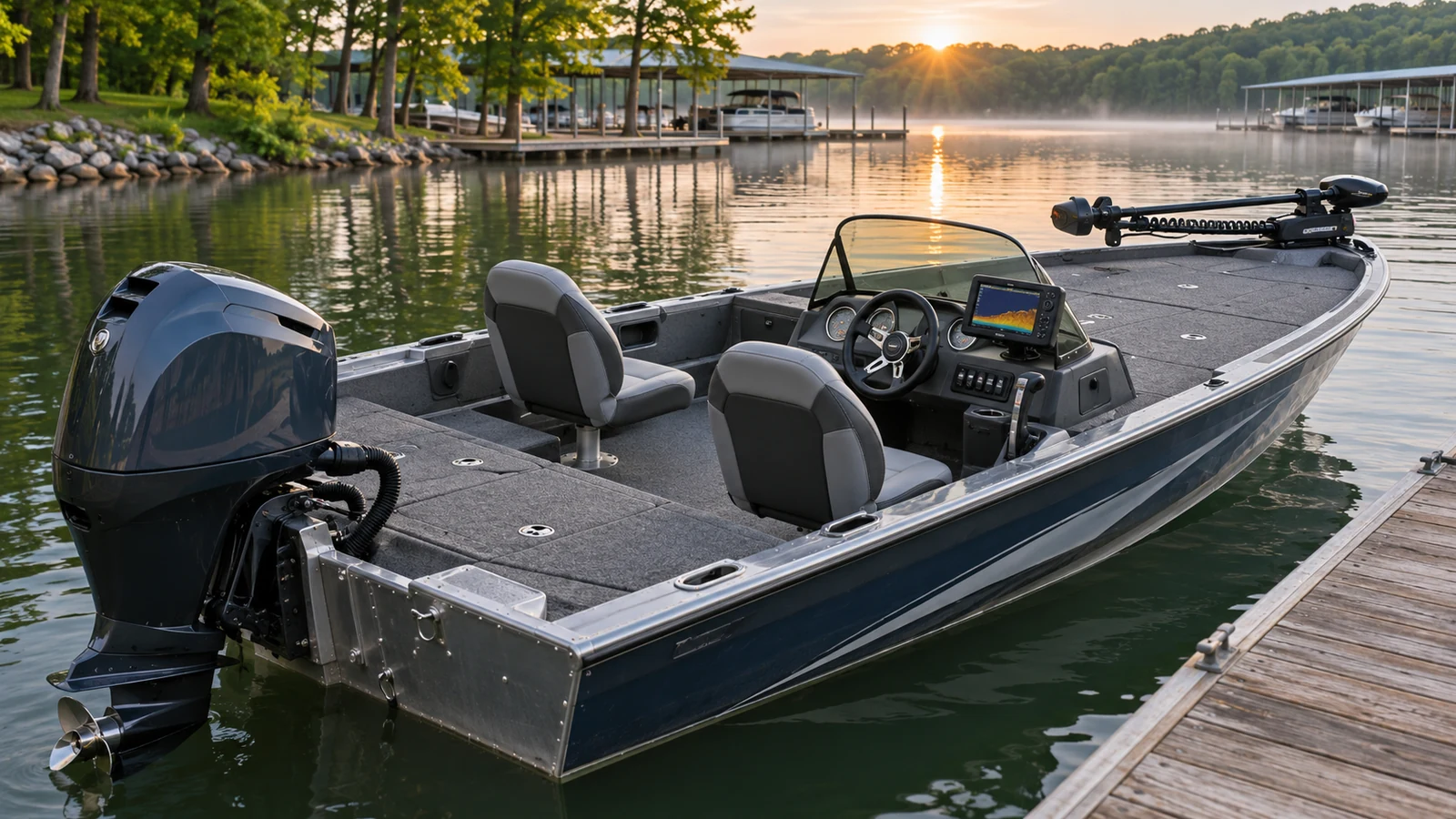
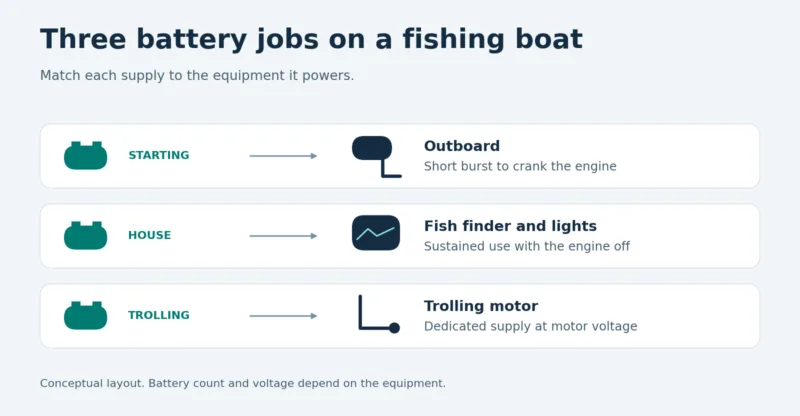
Start with the equipment already on your boat. The outboard manual sets the starting requirements, the trolling motor determines its bank voltage, and the time you spend running electronics determines how much capacity those loads need.
How the three marine battery types compare
| Battery type | Main job | What to check before buying |
|---|---|---|
| Marine starting battery | Supply a short burst of current to crank the outboard | Required voltage, MCA or CCA, any minimum capacity and approved chemistry |
| Deep cycle marine battery | Run a trolling motor, fish finder, lights or other loads over time | Bank voltage, usable capacity, discharge current and charging profile |
| Dual purpose marine battery | Start the engine and support light accessory use on a shared battery | Required cranking rating, usable capacity, cycling limits and typical time with the engine off |
A boat can have separate starting, house and trolling motor circuits. How many batteries those circuits need depends on the equipment voltage and the loads you plan to run together.
How to choose a marine starting battery
Find your outboard’s exact model and year. The battery section of the owner’s manual may specify minimum marine cranking amps (MCA), cold cranking amps (CCA), capacity or battery type. Compare the rating on the replacement battery with the same rating in the manual. MCA and CCA are measured under different test conditions, and a battery’s amp-hour rating describes capacity.
Also check the terminal positions, cable reach, mounting and clearance above the terminals. Two batteries can have the same voltage and cranking rating yet fit the battery tray differently. Measure the inside of the tray and the opening you need to lift the battery through.
How to size a deep cycle marine battery
For a trolling motor, start with the rated system voltage. Size capacity using the motor’s average draw at the speeds and conditions you fish in. Check the manufacturer’s maximum draw separately against the battery’s discharge limits and follow the motor instructions for wiring and circuit protection.
For electronics on a common 12V supply, multiply each device’s average current by its expected hours of use, then add the results. A fish finder drawing an assumed 1.5A for six hours uses 9Ah. Lights averaging 0.5A for two hours add 1Ah. Together they use an estimated 10Ah. Add any other loads that can run while the engine is off, then allow a reserve when you size the battery.
Those figures are an example. Use measured draw or the device’s electrical specifications for your own boat. If a device runs through a converter, include the current it draws from the battery side of the converter.
Can one battery start the engine and run the fish finder?
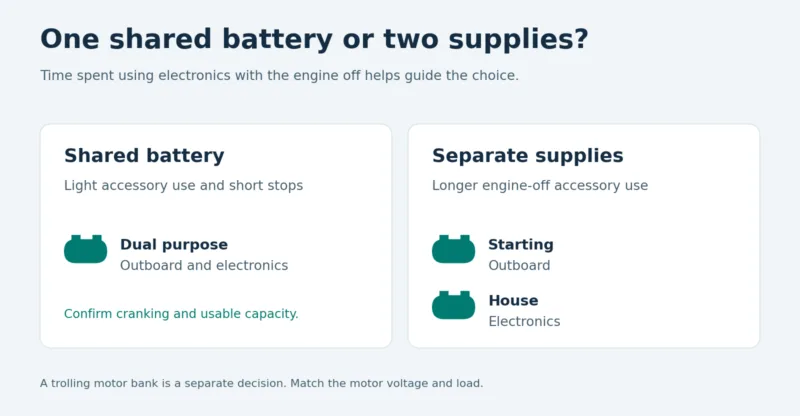
A dual purpose battery can make sense on a small boat with room for one battery, light accessory use and short stops with the engine off. The battery still has to meet the engine’s starting requirements. Use the electronics budget above to compare trips, and check the battery maker’s guidance on cycling and state of charge before relying on a shared battery. An accessory budget in amp-hours does not establish the cranking current available after several hours of use.
| How you use the boat | Layout to evaluate first |
|---|---|
| Short stops with a fish finder and limited tray space | A dual purpose battery that meets the outboard requirements and can support the expected accessory use |
| A long day with multiple displays, pumps or lights running while anchored | A starting battery plus a separate house battery sized for the equipment |
| A 24V or 36V trolling motor and 12V electronics | A dedicated trolling motor bank and a compatible 12V supply for electronics |
If you have a 12V trolling motor and a 12V fish finder, check both manuals before sharing a deep cycle supply. Include both loads in the capacity estimate. If the display resets or shows interference when the motor runs, review the supply voltage and installation with the equipment maker or a marine technician. On a 24V or 36V series bank, avoid taking 12V from just one battery because the extra load will discharge that battery faster than the rest.
Can you use lithium for engine starting?

Use a lithium battery for engine starting only when the battery maker rates it for cranking and the outboard manufacturer permits that battery type for the specific engine. Confirm the required starting rating and the compatibility of the engine’s charging system and any onboard charger. Check any battery management system limits that apply during cranking or charging.
The VTCBATT 12V 100Ah LiFePO₄ battery is an example of a deep cycle model. Its product guidance specifies deep cycle use and excludes engine cranking. Evaluate it for compatible sustained loads using the device voltage, current draw and charging requirements. VTCBATT 12V 100Ah LiFePO₄ specifications
Marine battery buying checklist
- Outboard — Record its exact model and the starting battery requirements from its manual.
- Trolling motor — Record its rated voltage, maximum draw and expected hours of use.
- Electronics — List the devices that run with the engine off, their current draw and estimated operating time.
- Installation — Measure the tray, hatch opening, terminal clearance and cable reach.
- Charging — Record the onboard charger model and check how each battery will recharge, including any engine charging connection.
For a VTCBATT enquiry, send the equipment models, load estimates and tray measurements. Specify whether you need a battery for starting, house loads or trolling so the proposed model can be checked against that job.


