

This guide compares LiFePO₄ options for a 36V trolling motor. Runtime figures below are planning calculations, not on-water test results or a guarantee for a particular battery.
If your boat already has three battery trays, three matched 12V lithium batteries approved for series use may fit the existing layout. If you have one compartment that can hold the entire battery, a single 36V lithium marine battery removes the need for jumpers between batteries. Check how each option fits through the hatch, then confirm that it works with your trolling motor and charger.
At an assumed average bank draw of 25A, a 100Ah bank gives a calculated 3 hours and 12 minutes with a 20% reserve. Four hours under the same assumptions requires 125Ah of rated capacity before allowing for reduced available capacity or more demanding conditions.
Will a 36V lithium battery work with your trolling motor
Lithium battery compatibility depends on the exact trolling motor model and generation. Check the motor manual for supported battery chemistry, input voltage and any operating limits.
Look up your exact motor model. Confirm that the manufacturer allows the battery chemistry and find the permitted input-voltage range. Check the battery’s full-charge voltage against the motor’s upper limit. For example, three 12.8V LiFePO₄ batteries have a combined nominal voltage of 38.4V. Use the battery maker’s actual full-charge specification for the whole bank when checking compatibility.
Use the motor’s maximum draw to screen for discharge capability. Ask the battery maker for the continuous current rating and the duration of any higher peak rating. On a series bank, all three battery management systems (BMSs) must handle the same current. If other equipment runs from the bank at the same time, include its draw. Use the motor manufacturer’s instructions to select the wiring and circuit protection for the model and cable run.
One 36V pack or three 12V batteries in series
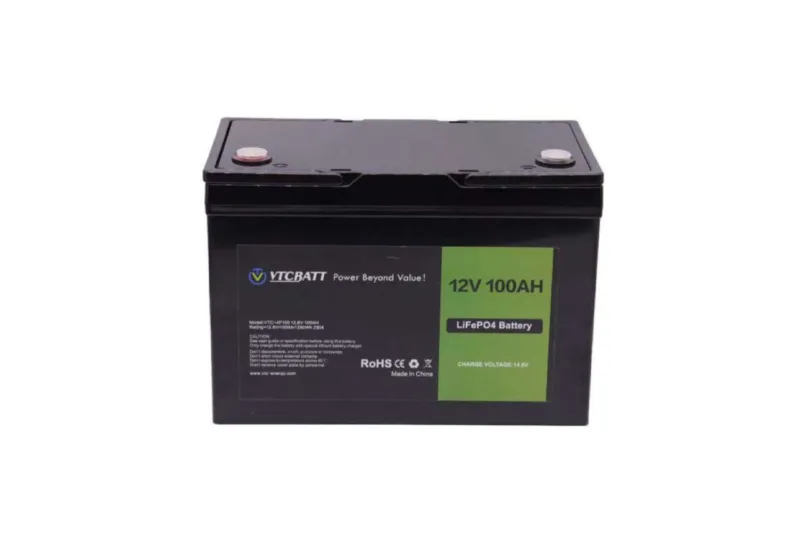
Figure 1. VTCBATT 12V 100Ah LiFePO4 battery, shown as one module in the three-battery option. Product image from VTCBATT.
A single pack gives you one battery to secure and removes the two jumpers used in a three-battery series bank. Three modules let you carry them aboard one at a time and may fit trays spread across the boat. Measure both options before ordering, especially if the hatch is narrower than the compartment behind it.
| What to compare | One 36V-class pack | Three matched 12V modules |
| Fit | One tray sized for the pack and its terminal clearance | Three secured trays with room to route two jumpers |
| Handling | Lift the entire pack into position | Move and secure one module at a time |
| Capacity | Check the rating of the selected pack | Three series-approved 12.8V 100Ah modules give 38.4V nominal and 100Ah |
| Charging | Match a charger to the full pack’s requirements | Verify whether the manufacturer permits whole-bank charging or charging each module separately |
| Replacement | Service or replacement involves the complete pack | Replacing one module requires approval to match it with the remaining modules |
| Installed cost | Include the pack, suitable charger, mounting and wiring | Include all three modules, jumpers, mounting and any charging changes |
Three 12.8V 100Ah batteries in series make a 38.4V nominal, 100Ah bank—not a 300Ah bank. Its calculated nominal energy is 38.4V × 100Ah = 3,840Wh. Compare usable watt-hours, discharge capability and total installed cost when evaluating an alternative single pack; do not assume its energy from the “36V” label alone.
As a product example, the VTCBATT 12V 100Ah product page lists support for up to four batteries in series and requires identical models with matching voltage, capacity and BMS type, purchased within six months. Treat this as published product guidance: request the current datasheet and written confirmation for the exact three-module configuration, motor and charger you intend to use. This example does not establish approval for every 36V trolling motor.
How long will a 36V 100Ah battery last
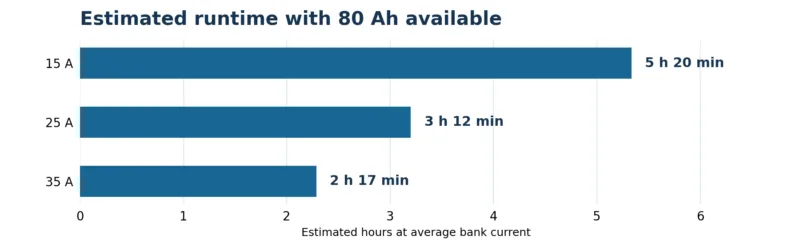
Figure 2. Calculated runtime for a 100 Ah bank with a 20% reserve.
For a fully charged 100Ah bank with a planned 20% reserve, budget 80Ah for the trip. Divide that budget by the average current drawn from the bank over the period you want to estimate.
Estimated hours = rated Ah × planned usable fraction ÷ average bank current in amps. Here, the usable fraction is 0.80. The 20% reserve is a planning choice, not a measured BMS cutoff or a universal battery limit.
| Average bank current | Estimated runtime on an 80Ah budget |
| 15A | 5 hours 20 minutes |
| 25A | 3 hours 12 minutes |
| 35A | About 2 hours 17 minutes |
These are assumed average loads, not current ratings for specific motors. The calculation assumes the battery can deliver its rated capacity in the operating conditions. Temperature, battery age, imbalance in a series bank and an early BMS cutoff can reduce the available capacity. A 100Ah label describes charge capacity; it does not mean the battery can deliver 100A continuously.
For a four-hour trip at an average of 25A, the bank would supply 100Ah. Divide 100Ah by 0.8 to leave the same reserve, giving an estimated requirement of 125Ah rated capacity.
If you have a battery monitor, record the amp-hours used on a representative trip and divide by the elapsed hours. Use the same time window when planning your next trip, including time spent at low speed or with the motor off. Include other loads powered by that bank. A day spent holding position in wind or current may draw more than a calm outing, so compare readings from the conditions you actually fish in.
Can you reuse your existing trays and charger
Measure the route into the compartment. Record the hatch opening, tray dimensions and clearance above the terminals with the lid closed. Check the terminal orientation, cable reach and mounting points. With three trays, also check how the jumpers will run between them.
Check the charger’s exact model. If you move from three 12V batteries to one 36V-class pack, check for an output that meets the new pack’s charge-voltage, current and profile requirements. Some onboard chargers provide three outputs for individual 12V batteries. If you keep the three-module layout, verify the charge profile for each battery and confirm that both manufacturers permit the proposed setup, including whether the outputs are isolated and the series jumpers can stay connected during charging.
A three-bank 12V charger rated at 10A per bank supplies that current to each individual battery. Do not combine charger leads to charge a single pack unless the charger manufacturer explicitly specifies that configuration. For an approved three-module setup, replacing 80Ah in each module at 10A per module gives an idealized eight-hour calculation; allow additional time for charging stages and operating limits. Check recharge time against the hours available before the next trip.
Plan a supply for 12V accessories. Use a separate compatible supply, or a suitable DC–DC converter where permitted, for the fish finder and lighting. Keep engine starting as a separate compatibility decision: a trolling battery’s Ah rating does not establish cranking suitability. Avoid drawing accessory power from one module in the series string because this discharges it faster than the others. Use a dedicated starting battery that meets the engine manufacturer’s cranking requirements.
Check the installation environment. Request the exact enclosure ingress-protection rating, permitted mounting orientation, charging-temperature range and low-temperature charging behavior. Ask whether low-temperature protection or heating is included in the quoted model. A “marine” product description alone does not answer these questions.
What should you check before you order
Use the following checklist to request a comparable quote for both layouts.
| Information to provide | Confirmation to request |
| Motor make, exact model and year/generation | Supported chemistry and full-charge voltage; discharge-current requirements |
| Target operating hours and measured average bank current | Capacity calculation, reserve assumption and usable-energy specification |
| Hatch opening, tray dimensions and terminal clearance | Dimensioned drawing, weight, terminal layout and mounting requirements |
| Existing charger model and overnight charging window | Approved wiring arrangement, charge profile and expected recharge time |
| Lowest charging temperature and exposure to water | Charging limits, protection behavior and enclosure rating |
| Single-pack or three-module preference | Exact model numbers, series approval where needed, warranty terms and replacement procedure |
For a VTCBATT enquiry, send these details with your current wiring layout and ask for a model-specific proposal. Compare the complete installed cost, including charging and mounting changes. Choose three modules when the approved configuration fits your existing trays and charging equipment; choose one pack when its fit, charging requirements and discharge capability check out and you want fewer external battery connections.
The runtime and recharge figures are planning estimates based on the assumptions shown above.


