
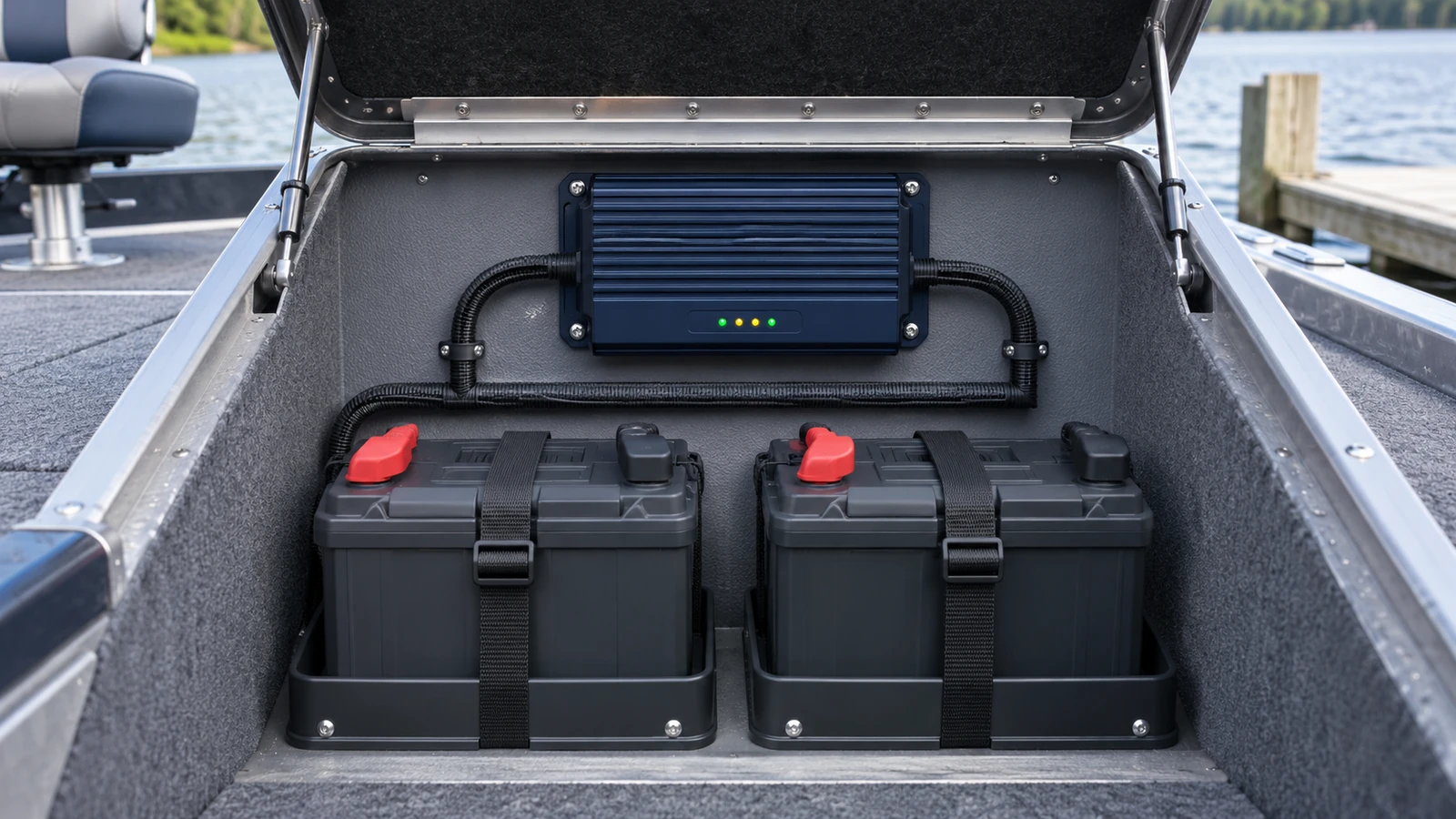
Once you’ve identified the layout, compare the charger’s output voltage, charging profile, and current with the battery specifications. The battery label and the charger’s model number will help you find the right manuals.
Identify what each output will charge before choosing a charger.
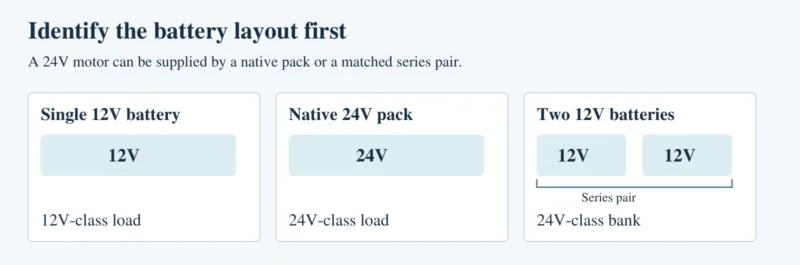
What does each charger output connect to?
List the batteries on board and note what each one powers. A small boat might have a single 12V battery for its electronics. A boat with a 24V trolling motor may have one native 24V pack or a pair of 12V batteries in series. It may also have a separate 12V starting battery or house battery. Read the label on each battery and check the boat’s wiring diagram before identifying the charger outputs you need.
On a charger, a bank usually means one charging output. On a boat, the same word may refer to a group of connected batteries. A two-bank charger can have two separate 12V outputs. Read the per-output voltage and check the manual for how the outputs may be used. Also check whether the charger can set the chemistry separately for each output if you plan to charge different battery types. Minn Kota marine battery charger buying guide
When do you need a 24V charger or two 12V outputs?
For a native 24V battery, match the charger to the pack’s charging port or terminals and the battery manufacturer’s full-pack specifications. If you have a series pair and its manufacturer approves charging across the whole bank, compare 24V-class chargers against the specified voltage, profile, and current for that configuration.
Some onboard chargers can charge each 12V battery separately while the batteries remain connected in series. This requires appropriately isolated outputs and an explicit connection diagram for your charger. Verify that the battery manufacturer permits the arrangement too. Use the manual for the exact charger model to confirm how its outputs behave and which connections are permitted.
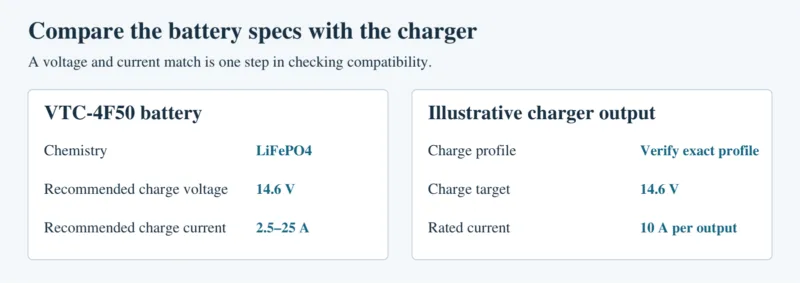
Table 1. Match the charging output to the battery layout
| Battery layout | Candidate charger output | What to confirm |
| One 12V battery | One matched 12V-class output | Chemistry, charge profile, and current |
| One native 24V battery | One matched 24V-class output | Full-pack specifications and charging interface |
| Two 12V batteries in series | Approved 24V-class output across the bank | Battery manufacturer permits whole-bank charging |
| Same two 12V batteries | Two isolated 12V-class outputs, one per battery | Charger and battery manuals permit individual charging in the series layout |
If the same charger will serve an engine starting battery, map out that output separately. For example, a boat can have two approved outputs serving its two 12V trolling batteries and a third serving a 12V AGM starting battery. Verify that the model supports each battery’s profile and the proposed setup.
How do you read the battery and charger labels together?
Start with the battery’s chemistry, then find its recommended charging voltage and current. The VTCBATT VTC-4F50 is a 12V-class 50Ah LiFePO4 battery. Its product specifications list a recommended charge voltage of 14.6V and a recommended charge current of 2.5–25A. Use the recommended settings as the comparison point and keep the BMS protection thresholds separate. VTC-4F50 charging specifications
Check voltage, current per output, and the complete charging profile.
Table 2. Compare a battery specification with a candidate charger
| Item | VTCBATT VTC-4F50 | Illustrative charger output |
| Chemistry | LiFePO4 | Verify the exact supported profile |
| Recommended charging voltage | 14.6 V | 14.6 V charge target |
| Recommended charging current | 2.5–25 A | 10 A per output |
The illustrative output matches the recommended voltage, and 10A falls within the listed current range. Before calling the charger compatible, check the voltage and behavior at each charging stage, any maintenance or reconditioning mode, and the battery’s allowed charging temperature. Apply the same process to a 24V lithium marine battery using its own specifications. If you’re reusing an older lead-acid charger, start by identifying the modes it can actually run. VTCBATT guide to lead-acid chargers and lithium batteries
What does amps per bank mean for charging time?
Compare the current listed per output with the battery’s recommended range. If one battery needs 30Ah and receives a steady 10A, the ideal estimate is three hours. Allow extra time if the charger tapers its output near full charge, reduces current in a hot compartment, or supplies other loads on the boat while charging.
For two 12V batteries that each need 30Ah, an approved two-output charger capable of delivering 10A to each battery simultaneously gives the same three-hour ideal estimate per battery. A rating of 20A total can describe that arrangement, so look up how the current is distributed and whether both outputs can deliver their labeled rating at once. The estimate assumes each battery receives the stated current for the full period.
What else matters for an onboard installation?
Check the charger manual for the permitted mounting location, clearance, and exposure to water or spray. Measure the cable path to the batteries and confirm that the manufacturer allows the planned length and routing. Check the battery and charger temperature limits if you recharge in an unheated garage or leave the boat at a cold dock. For a replacement charger, keep photos of both labels and note which outputs serve the starting battery and trolling bank. That makes it easier to confirm a match before you buy.
A label check also helps when you’re keeping a charger through a battery upgrade. Before removing the old battery, write down the charger’s exact model and the mode currently selected. In the manual, find the charge profile for the replacement chemistry and record its target voltage and current. For a multi-output charger, do that once for each connected battery, including any starting battery you intend to keep. Where an output profile or series arrangement is unclear, share the charger model and battery model with the manufacturers so they can confirm the proposed setup.
Frequently asked questions
Can a regular 12V charger charge a native 24V pack?
A single 12V output is designed for a lower voltage class. Use a charger whose output matches the native 24V pack’s full charging requirements. If your system is built from two 12V batteries, check the manuals for the approved ways to charge that series bank.
Can one output charge AGM and another charge LiFePO4?
Some chargers offer an independent battery profile for each output. Confirm that the exact model supports both chemistries on separate outputs and compare each profile with the connected battery’s requirements. Minn Kota Precision charger per-bank profile selection


